If you are pricing infrastructure for a database, high-traffic application, or private business system, the question usually comes up fast: what is bare metal hosting, and why would you choose it over a VPS or shared cloud instance? The short answer is simple. Bare metal hosting gives you a physical server dedicated to your workload alone, with no hypervisor layer dividing CPU, RAM, or storage among other tenants.
That single point changes a lot. Performance becomes more predictable, hardware access is direct, and configuration options are broader. At the same time, bare metal is not automatically the right answer for every project. It offers control and consistency, but it can require more planning, more system administration, and a different approach to scaling.
What is bare metal hosting?
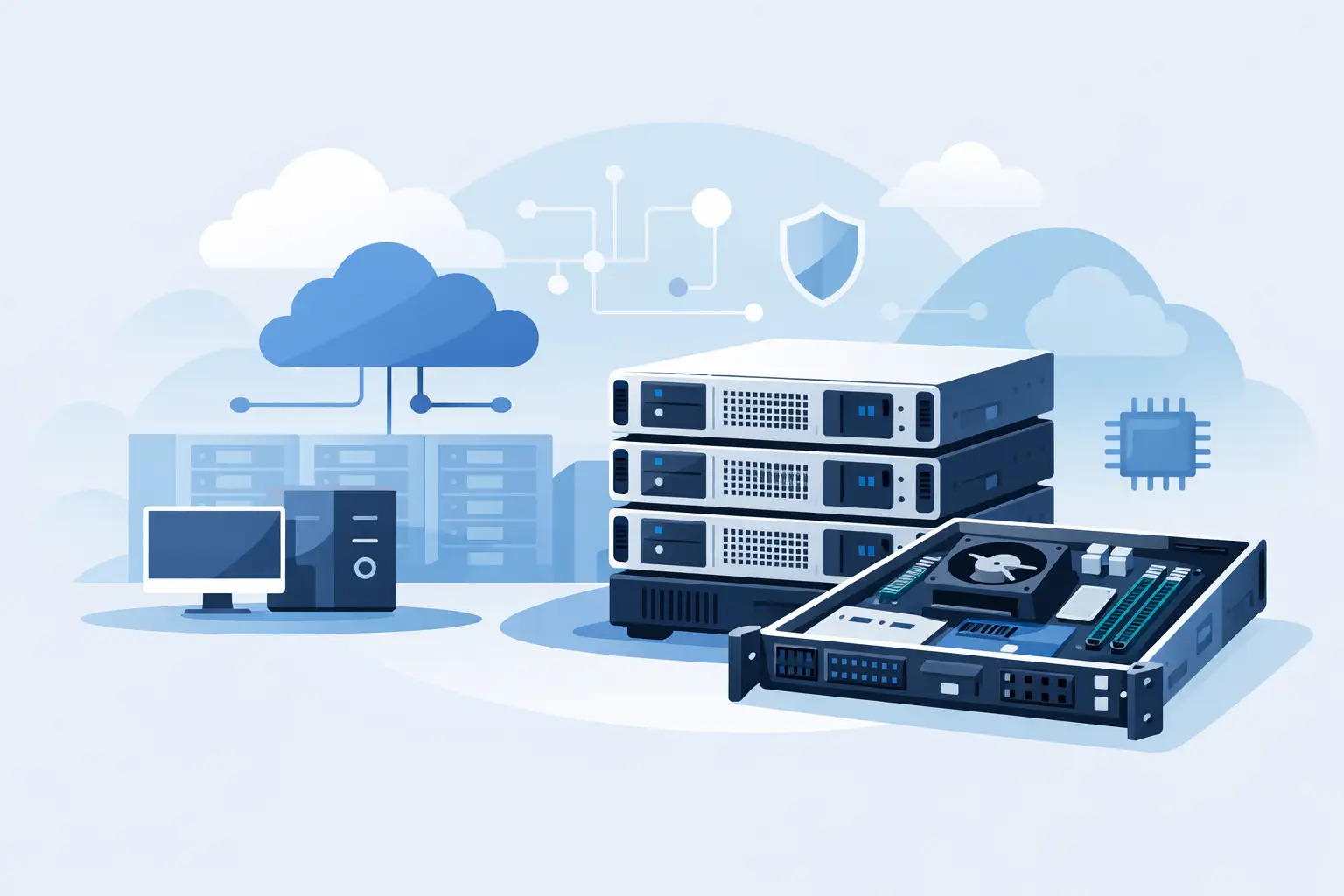
Bare metal hosting is a service where a provider rents you an entire physical server. Unlike shared hosting or most VPS platforms, the machine's resources are not carved up for other customers. You get dedicated CPU cores, dedicated memory, dedicated local storage, and full control over the operating environment.
In practical terms, that means your application runs on the hardware itself rather than inside a virtual machine sharing a host with unrelated workloads. You can install your preferred operating system, tune the kernel, configure RAID, choose storage layouts, and often select hardware options that fit the job.
The term "bare metal" refers to direct access to the underlying server hardware. There is no abstraction layer in the middle consuming resources or introducing the same kind of noisy-neighbor risk you see in multi-tenant environments.
How bare metal hosting differs from VPS and cloud
A VPS is also a private environment from the user's point of view, but it sits on a larger physical host alongside other virtual servers. That model is flexible and cost-effective, especially for websites, small business applications, development systems, and workloads that scale in modest steps. For many customers, it is the right starting point.
Bare metal hosting shifts the balance toward isolation and consistency. Since the full server belongs to one tenant, resource contention is lower and performance behavior is easier to predict. This matters when applications are sensitive to CPU scheduling, disk I/O variation, or memory pressure.
Cloud instances sit somewhere else on the spectrum. They are often easier to provision quickly, clone, resize, and integrate with larger platform services. The trade-off is that the infrastructure is more abstracted. That abstraction is useful, but it can make hardware-level tuning harder and long-running, stable workloads more expensive than expected.
If a VPS is about efficiency and flexibility, bare metal is about direct access and guaranteed capacity.
Why businesses choose bare metal hosting
The main reason is performance. When a server is not sharing hardware with unknown neighbors, applications tend to behave more consistently under load. That is valuable for production databases, ERP systems, analytics platforms, game servers, media processing, and busy web applications where response time matters.
Security and isolation are also part of the appeal. Bare metal does not remove the need for proper hardening, patching, or access control, but it does reduce exposure to the risks that come with multi-tenant infrastructure. Some organizations also prefer dedicated hardware for internal policy, software licensing, or compliance reasons.
Then there is control. With bare metal, you are less constrained by the virtualization platform. You can choose a specific CPU family, define custom partitioning, work with hardware RAID or software RAID, attach specialized storage, and build around exact workload requirements rather than fitting into a generic instance type.
For businesses running steady, resource-heavy workloads, cost can be another reason. A well-sized dedicated server can be more economical than a continuously running cloud deployment with equivalent compute and storage performance.
What you actually get with a bare metal server
The service itself varies by provider, but the core model is consistent. You rent a physical machine in a data center and receive administrative access to it. Depending on the offer, you may be able to choose the CPU generation, memory size, storage type, bandwidth allocation, control panel, operating system, backup setup, and management level.
Some deployments are fully self-managed. Others include support for monitoring, operating system updates, security maintenance, or hardware replacement coordination. That distinction matters. A business with in-house Linux or Windows administration may want full control, while a smaller team may need a more managed setup.
This is where an infrastructure-focused provider can make the difference. Hardware is only part of the service. Network quality, data center standards, remote hands availability, replacement procedures, and access to adjacent services such as object storage, colocation, DNS, or virtual environments all affect the long-term value.
When bare metal hosting makes sense
Bare metal is a strong fit when your workload needs sustained performance and cannot tolerate much variance. A busy MySQL or PostgreSQL database is a common example. So is an application stack with predictable baseline demand that runs around the clock.
It also makes sense when you need full operating system control. If your team wants custom kernel modules, specific security tooling, or storage tuning that a VPS environment does not support, dedicated hardware is often the cleaner option.
Licensing can also push businesses toward bare metal. Some commercial software is licensed per server, per socket, or per core in ways that are easier to manage on dedicated hardware. In those cases, bare metal is not just a technical choice but a budgeting one.
Agencies and infrastructure buyers also choose bare metal when they want to separate client environments physically, run virtualization on top of their own hardware, or build hybrid setups that combine dedicated servers with VPS nodes and object storage.
The trade-offs to keep in mind
Bare metal hosting is not the most elastic option. You cannot usually resize a physical server in seconds the way you can with many cloud platforms. If you outgrow the hardware, scaling may require migration to a larger machine, adding more servers, or redesigning the application stack.
Provisioning can also take longer. A cloud instance may start in minutes, while a bare metal deployment may involve hardware assignment, testing, OS installation, and custom configuration. For production workloads, that extra time is often reasonable. For short-term experiments, it may be unnecessary.
Management overhead is another factor. More control means more responsibility unless the provider offers managed services. You still need to think about backups, patching, security policy, monitoring, disaster recovery, and capacity planning.
Then there is utilization. If your workload is small or bursty, renting a whole server may leave resources sitting idle. In that case, a VPS or cloud instance can be a more efficient use of budget.
What is bare metal hosting best for?
The best use cases are steady, demanding workloads that benefit from dedicated compute and storage. That includes database servers, line-of-business applications, busy eCommerce platforms, game infrastructure, CI runners, virtualization hosts, and analytics jobs that need reliable throughput.
It is also well suited for organizations that want predictable monthly costs. Variable cloud bills can be a problem when resource usage drifts upward over time. A fixed dedicated server price can make budgeting easier, especially for SMBs and agencies managing several production systems.
That said, bare metal does not have to replace everything else. Many environments work best as a mix. You might keep the database on dedicated hardware, run front-end services on VPS instances, and store backups in object storage. That kind of split often gives better performance and cost control than forcing every workload into one model.
How to decide between bare metal and other hosting options
Start with the workload, not the marketing term. Ask how sensitive the application is to latency, storage performance, and resource contention. Look at whether demand is stable or highly variable. Check whether your team needs low-level system control or simply wants a dependable place to run standard applications.
Next, evaluate the operational side. If your team is small, a lower-maintenance VPS setup may be the better fit unless the performance requirements clearly justify dedicated hardware. If you already manage infrastructure comfortably, bare metal can provide a cleaner, more predictable platform.
Finally, compare the full cost rather than headline pricing alone. Include bandwidth, backups, support, control panels, replacement timelines, and the effort required to maintain the system. Cheap infrastructure stops being cheap when it creates avoidable administration or performance problems.
Internetport works with customers across this range, from straightforward hosting needs to dedicated infrastructure and custom deployments, and that is often the right way to think about bare metal too. It is not a prestige upgrade. It is a tool for the jobs that need it.
The best hosting choice is the one that matches how your application behaves in the real world, not just how it looks on a product page.